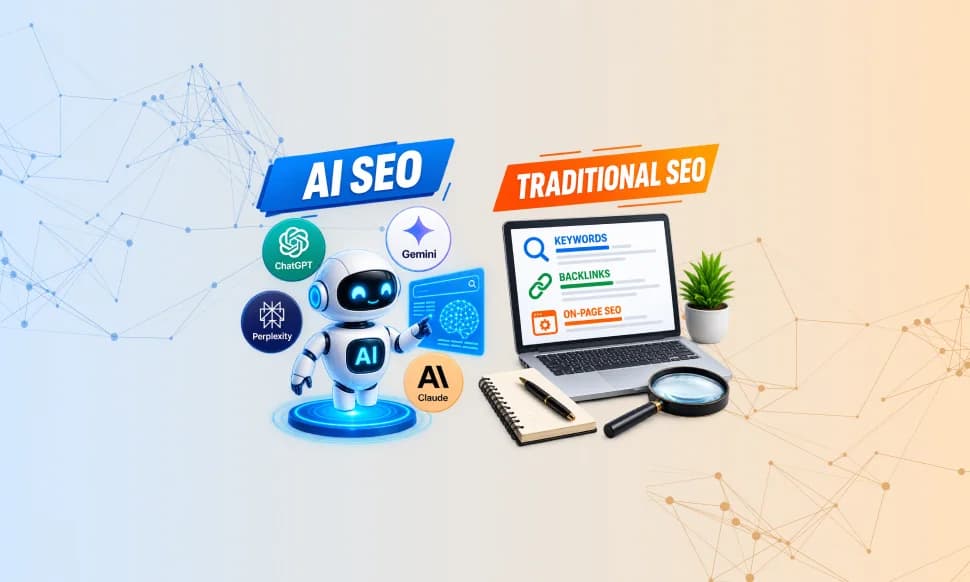
AI search tools like ChatGPT and Perplexity are changing how Indian buyers discover businesses. This guide breaks down what AI SEO adds, what traditional SEO still does, and what you should fix first in 2026.
The Search Landscape Changed — Did Your SEO?
Something fundamental shifted in how people find businesses online. It wasn't the Helpful Content Update. It wasn't the Core Web Vitals rollout. It was the moment a significant portion of search queries started going to ChatGPT, Perplexity, Google AI Overviews, and Gemini — instead of ten blue links.
A procurement manager looking for a 'web development agency for a pharma company in Mumbai' no longer necessarily clicks through to ten websites and compares them. They ask an AI assistant, get a synthesised answer, and — if your brand isn't in that answer — you don't exist for that buyer at that moment.
This is the new reality of SEO for Indian businesses in 2026. And it requires a fundamentally different approach alongside (not replacing) traditional SEO.
Traditional SEO gets you to page one of Google. AI SEO gets you into the answer. Both matter. The companies ignoring AI SEO are building audience in a channel that's shrinking relative to AI-mediated discovery.
What Traditional SEO Still Does Well
Let's not throw the baby out with the bathwater. Traditional SEO — keyword targeting, technical optimisation, link building, on-page SEO — still drives significant volume for Indian businesses. Google remains the dominant search engine by share. Blue link results still get clicked for many query types.
Traditional SEO still works well for:
- Local SEO — 'web development company in Mumbai' type queries where intent is highly geographic
- Transactional queries — 'buy industrial safety equipment online India'
- How-to and tutorial content — still well-served by Google search results
- Comparison queries — 'WordPress vs Shopify India' where users want to read and compare
If you abandon traditional SEO entirely because AI search exists, you'll lose volume from channels that still convert. The answer is integration, not replacement.
Still figuring out whether your traditional SEO foundation is solid?
Here's what every Indian business should have covered first →
Top SEO Strategies to Follow in 2026
What AI SEO Adds (And Why It's Different)
AI search engines work differently from traditional search engines. Google's traditional algorithm ranks pages. AI systems synthesise answers from multiple sources and choose which brands to reference — or not reference. Being 'rankable' is not the same as being 'citable by AI.'
To be cited by AI systems, your content and brand need to demonstrate:
Entity clarity — AI systems know exactly who you are
Your brand, services, location, industry, and expertise need to be consistently and unambiguously defined across your website, Google Business Profile, LinkedIn, industry directories, and any publication that mentions you. AI systems build a knowledge graph — if your entity definition is inconsistent or weak, you're less likely to be cited confidently.
Authoritative depth — not just breadth
AI search rewards genuine expertise. A website with 50 shallow 500-word articles on broad topics will be cited less often than a site with 10 comprehensive, deeply researched articles on specific questions that a real expert would write. This shifts SEO content strategy from volume to depth.
Direct answer structure
AI systems extract answers from content. A page that buries its main answer in paragraph 8 after 400 words of preamble is less citable than a page that answers directly in the first 100 words and then provides the detail. Writing structure needs to change for AI-extractable content.
Trust signals at scale
AI systems use trust as a ranking factor — but they measure it differently than Google PageRank. Citations from authoritative sources, mentions in industry publications, consistency of information across platforms, and review scores across directories all contribute. Building digital credibility is a broader exercise than link building alone.
The AI SEO Checklist for Indian Businesses in 2026
Answer Engine Optimisation (AEO): The New Discipline
AEO — Answer Engine Optimisation — is the practice of structuring your content so that AI systems (ChatGPT, Perplexity, Google AI Overviews, Gemini) are more likely to cite your brand when answering relevant questions.
For 12Grids, AEO means ensuring that when a business owner asks 'who are good web development agencies in Mumbai?' — we appear in the AI's answer. This requires:
- FAQ sections on every service page, written in conversational language that matches how people ask AI systems questions
- Clear, structured answers to 'what does X cost?' and 'how does X work?' — the most common query structures in AI search
- Consistent brand entity definition — the same name, location, specialisations, and service descriptions across every platform where we appear
- Genuine industry citations — being mentioned in articles, directories, and publications that AI systems consider authoritative sources
We've been implementing AEO for our own content and for select clients since early 2025. The evidence of impact is growing — specific branded queries and service queries are generating AI Overview appearances that didn't exist 12 months ago.
Want to know exactly how AI systems decide which brands to cite — and which get skipped?
Here's the full breakdown →
Answer Engine Optimisation (AEO): How Indian Businesses Get Found in ChatGPT, Perplexity & Google AI Search
How to Measure AI SEO Impact
Traditional SEO measurement is relatively straightforward: keyword rankings, organic traffic, conversions. AI SEO measurement is still evolving, but practical approaches include:
- Brand mention monitoring: Tools like Mention, Brand24, or manual checks across Perplexity and ChatGPT for your key query categories
- Google AI Overview tracking: Google Search Console now provides some data on AI Overview appearances — track this monthly
- Direct traffic monitoring: As AI-driven discovery increases, direct traffic often increases — users who found you via AI search type your URL directly or search your brand name
- 'How did you find us?' in discovery calls: The most qualitative but often most revealing data point
What 12Grids Does for AI SEO
Our SEO services have evolved significantly over the past 18 months. Alongside technical SEO (Core Web Vitals, site architecture, schema), content SEO (pillar content strategy, keyword targeting), and off-page SEO (link building, digital PR), we now layer in:
- Entity optimisation — auditing and improving how your brand is defined across digital touchpoints
- AI-structured content — rewriting or restructuring existing content for extractability and direct answers
- FAQ strategy — building comprehensive FAQ ecosystems across service pages based on how real buyers ask questions
- Schema depth — implementing structured data that helps both Google and AI systems understand your content
- Citation building — identifying and securing mentions from sources that AI systems weight heavily
Want to see how a full SEO engagement actually looks ?
From technical audit to AI-structured content? →
Want to Know Where You Stand in AI Search Right Now?
We'll run an AI visibility audit — checking how your brand appears (or doesn't) in key AI search tools for your target queries. Then we'll give you a prioritised action plan.
→ Email: sales@12grids.com | +91 91379 97497

Kailash Vele
I lead the technology vision and architecture across all our products and client solutions — ensuring that innovation, scalability, and reliability are at the heart of everything we build. From Laravel to AI-powered systems, I work closely with our teams to implement frameworks that are not just functional, but future-ready. At 12Grids, I’m focused on driving engineering excellence, building clean and modular systems, and aligning our tech stack with business goals. Whether it’s launching a SaaS product, streamlining development workflows, or introducing automation for faster delivery, I believe great tech is built when structure meets speed. My core mission: to turn ideas into robust digital ecosystems that deliver real, measurable value.
Connect on LinkedInPut AI to work in your content engine
We design AI-native marketing workflows that ship - not demos.
Keep reading
View more →
Answer Engine Optimisation (AEO): How Indian BusinessesGet Found in ChatGPT, Perplexity & Google AI Search
llms.txt: What It Is, Why It Matters for Indian Businesses,and How to Create One Right Now
Product Engineering vs. Software Development: What Founders and CTOs Need to Know Before Hiring
Get the good stuff, monthly.
One thoughtful email a month - new research, playbooks, and ideas. No noise.